














































































































































The Search Behavior No One Is Optimizing For Yet
Most brands are still catching up to AI Overviews and ChatGPT citations.
Meanwhile, a much bigger shift is already underway.
AI agents are autonomous systems that interpret natural-language instructions, plan multi-step tasks, and execute them without human intervention. They are quickly becoming one of the primary ways people interact with information online.
When a user asks an AI agent to “research the best enterprise SEO platforms and summarize the top three options,” that agent doesn’t return a list of links. It reads, evaluates, synthesizes, and produces a final output based entirely on its interpretation of the prompt.
Your brand either shows up in that output, or it doesn’t.
This is the emerging discipline of agentic SEO: optimizing your content and digital presence specifically for how AI agents process prompts and generate agentic outputs. It’s one of the least-discussed shifts in search marketing, and brands that understand it first will hold a significant advantage.
This guide breaks down what agentic systems are, how they interpret prompts, and what you can do to position your brand as a preferred source in their outputs.
What Are Agentic AI Systems?
To understand why this matters, it helps to know how agentic systems differ from the AI tools most marketers are already thinking about.
Standard AI search tools (Google’s AI Overviews, Perplexity, ChatGPT in a basic session) operate in a single-turn mode. A user asks a question, the model synthesizes an answer, and the interaction ends.
Agentic systems work differently. They are designed to:
- Receive a high-level goal (not just a question)
- Break that goal into discrete steps
- Execute those steps autonomously, including web research, content analysis, API calls, and cross-referencing sources
- Produce a structured output such as a report, recommendation, summary, or action plan
Examples of agentic AI systems already in use include OpenAI’s Operator, Google’s Project Mariner, Anthropic’s Claude as an agentic assistant, and a growing ecosystem of enterprise automation tools built on top of large language models.
What makes them different from a marketing standpoint?
Traditional SEO and even standard AEO assume a human is evaluating the results and deciding what to click. Agentic systems remove the human from that loop entirely. The agent makes decisions on your behalf and decides which sources to trust, synthesize, and include in its final output.
That’s a fundamental change in how visibility works.
How AI Agents Process Prompts
To optimize for agentic outputs, you need to understand how an agent actually reads and interprets a prompt, and what that means for the content it pulls from the web.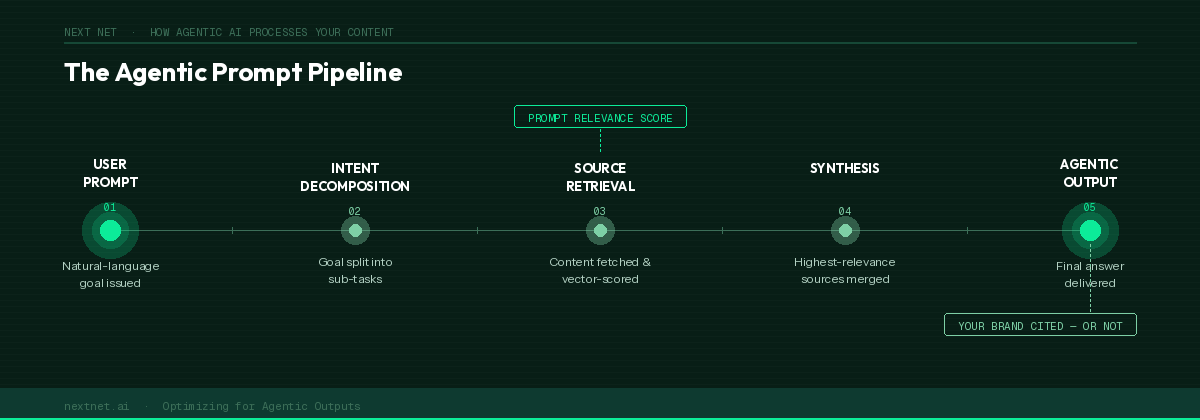
Step 1: Intent decomposition
When an agent receives a prompt, it doesn’t execute it literally. It first interprets the intent behind the request, breaking it into a series of sub-goals.
For example, the prompt “Find me the best link building services for an enterprise SaaS company” might decompose into:
- What defines “best” in this context? (Quality signals, scale, editorial standards, pricing)
- What is the profile of an enterprise SaaS company?
- Which sources discuss link building services with authority?
- How do I evaluate and rank them?
This means the agent is already working with a richer semantic model of what the user wants than any keyword-based system could produce.
Step 2: Source retrieval and scoring
Once the agent understands intent, it searches for relevant content. But unlike a search engine returning ten blue links, an agent retrieves content with a specific purpose: to extract usable information for its output.
As we covered in our guide to how queries are interpreted by embeddings, AI systems read your content as vector representations (mathematical relationships between concepts), not as keyword-matched text. This means:
- Topical depth matters more than keyword frequency
- Semantic clarity outperforms verbose filler
- Structured, extractable content performs better than narrative-only writing
Agents score sources on prompt relevance: how well does this piece of content serve the agent’s decomposed intent? Sources that score highly get referenced. Sources that don’t get skipped entirely.
Step 3: Synthesis and output generation
Finally, the agent synthesizes its findings into a coherent output. This is where agentic outputs are produced: summaries, comparisons, recommendations, and action plans that represent the agent’s best answer to the original prompt.
At this stage, only the highest-relevance sources make it through. The agent isn’t looking to be comprehensive. It’s looking to be accurate and useful to the human who issued the prompt.
If your content has been structured and positioned for prompt relevance, it has a chance of being woven into that final output. If not, it’s invisible, even if it ranks on page one of Google.
Prompt Relevance: The New Ranking Signal
In traditional SEO, ranking signals include backlinks, domain authority, on-page optimization, and click-through rates. These metrics tell search engines how popular and credible a piece of content is.
In the agentic world, prompt relevance functions as the primary ranking signal. It answers a different question: How precisely does this content serve the intent of a specific prompt?
Prompt relevance isn’t about keyword matching. It’s about:
- Conceptual alignment: Does your content address the exact topic, in the right context, at the right depth?
- Extractability: Can the agent isolate a discrete, accurate answer from your content without confusion?
- Trustworthiness signals: Does the content come from a source the agent’s underlying model associates with expertise and credibility on this topic?
- Structural legibility: Is the content organized in a way that makes it easy for the agent to parse relationships between ideas?
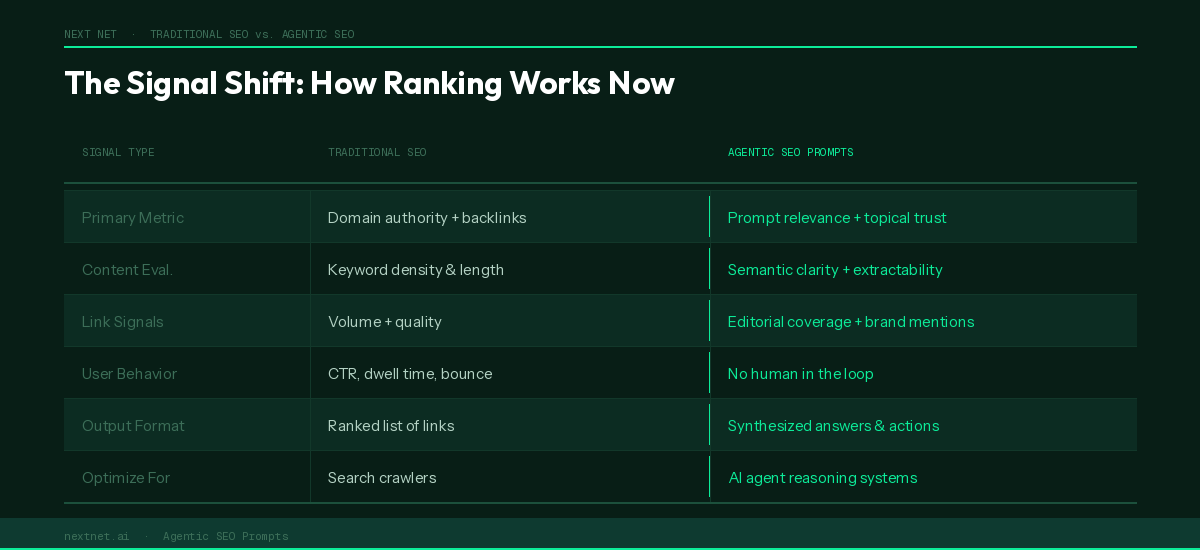 The implication is significant: brands optimizing only for traditional search rankings are building for a shrinking audience. As agentic usage grows, prompt relevance will determine who gets cited in the outputs that actually drive decisions.
How to Optimize for Agentic Outputs
The good news is that agentic SEO isn’t a complete departure from sound content strategy. It’s an evolution of it, with some specific new requirements.
Build content around prompt scenarios, not just keywords
Traditional SEO starts with keyword research. Agentic SEO starts with prompt scenario modeling: asking what is the full, natural-language request a person (or their AI agent) might submit that this content should answer?
Instead of optimizing a page for “enterprise link building,” write content that fully satisfies prompts like:
- “Compare the top enterprise link building services and explain how they source editorial placements”
- “What should a Fortune 500 company look for in a managed SEO provider?”
This shift changes how you structure content, what depth you go to, and how you handle subtopics. Every section of a post should be capable of standing alone as a self-contained answer to a specific sub-prompt.
Prioritize semantic density over volume
Agentic systems are fast and they don’t read linearly. They scan for conceptually dense content: passages where a high concentration of relevant meaning is packed into precise language.
Practical implications:
- Lead every section with a direct answer, then expand with context
- Eliminate filler and throat-clearing because agents don’t reward warm-up paragraphs
- Use tables, structured comparisons, and numbered frameworks that can be extracted cleanly
- Define your core concepts explicitly and don’t assume the agent will infer what you mean
Signal expertise at the entity level
AI agents don’t just evaluate content in isolation. They evaluate the source of that content against everything they know about that entity (your brand). This is where your broader digital footprint comes in.
Brand mentions in authoritative publications, editorial backlinks from credible media, and consistent expert positioning across your content cluster all contribute to how an agent weights your content when it’s deciding what to include in an agentic output.
In practical terms:
- Earn editorial coverage in trade press and major publications relevant to your category
- Build a dense content cluster around your core topics, because agents favor sources that demonstrate depth, not breadth
- Maintain entity consistency: your brand name, product names, and key value propositions should appear reliably across third-party sources
Structure for agent-readable extraction
Agents pull content programmatically, and certain structures are significantly easier for them to parse and extract. Specifically:
- FAQs with direct Q&A pairs because the format mirrors prompt/response logic natively
- Numbered step sequences since agents processing instructional prompts prefer explicit step-by-step structures
- Schema markup including FAQPage, HowTo, Article, and Organization schema to give agents labeled metadata that reduces ambiguity
- Subheadings as topical flags so every H2 and H3 functions as a clear signal of what the chunk below it covers
Monitor where your brand appears in agent outputs
Traditional rank tracking doesn’t capture agentic visibility. Start tracking your brand’s presence in AI-generated outputs by:
- Building a library of realistic prompt scenarios your target audience (or their AI agents) would submit
- Submitting those prompts regularly to ChatGPT, Perplexity, Claude, and Google’s AI Overviews
- Logging whether your brand is cited, referenced, or absent, and in what context
- Identifying the competitors and third-party sources that appear when you don’t
This manual audit, run consistently, is currently one of the most valuable competitive intelligence exercises a brand can run.
Final Thoughts: Agentic SEO Is Already Here
Most marketing teams are still building their AI search strategy around the idea of a human choosing from a list of results.
That model is already outdated.
The next wave of search behavior isn’t a person clicking a link. It’s an agent retrieving, evaluating, and synthesizing information on behalf of that person. The output that agent produces is the new first impression.
Agentic SEO prompts and prompt relevance aren’t future concepts to revisit next year. They’re active signals that are already shaping which brands get cited and which brands disappear from the consideration set entirely.
The brands building for this now (structuring content for extractability, earning editorial authority, and modeling their strategy around prompt scenarios instead of keywords) are positioning themselves to be the default answer when agents are tasked with finding the best option in their category.
Ready to see how Next Net translates prompts into performance?
Talk to our team to find out how we’re building agentic visibility strategies for enterprise brands right now.
Next Insight Suggestion: Inside the AI Search Stack: How Queries are Interpreted By Embeddings → https://nextnet.ai/vector-search-embeddings/