















































































































































SEO isn’t dying, it’s evolving into something new.
Enter generative engine optimization (GEO), a methodology that focuses on LLMs, vector search, and AI systems instead of classic search algorithms.
At this point, enough research has been done to paint a pretty clear picture: AI search is the way of the future.
According to Semrush, traffic from AI search users is set to surpass traditional search visitors by 2028.
That means even if you’re killing it with organic SEO right now, it won’t be long until AI starts to eat your traffic (if it hasn’t already).
The introduction of generative AI Overviews (AIO) on both Google and Bing didn’t help organic SEO, either.
Whenever an AIO is present for a keyword, it has the potential to drag down your click-through rate by more than 30%.
This trend is likely to intensify as AI platforms like ChatGPT and Perplexity continue to soar in popularity.
The best thing business owners and marketers can do right now is adapt to GEO before it’s too late.
In this post, we’ll compare SEO to GEO, and we’ll teach you how to develop a strategy that bridges the two.
What is GEO? Why is it Slowly Becoming the Norm?

Generative engine optimization, or GEO, is the practice of refining a website’s online content and presence to improve its visibility on generative AI search engines.
These ‘generative engines’ include:
Before generative AI, search marketing revolved around Google’s organic search results.
After ChatGPT and Google’s AI Overviews entered the picture, the playbook suddenly changed.
Google’s organic results began to take a backseat to AI-powered tools and search features, and marketers were quick to notice.
How AI changed the SEO funnel 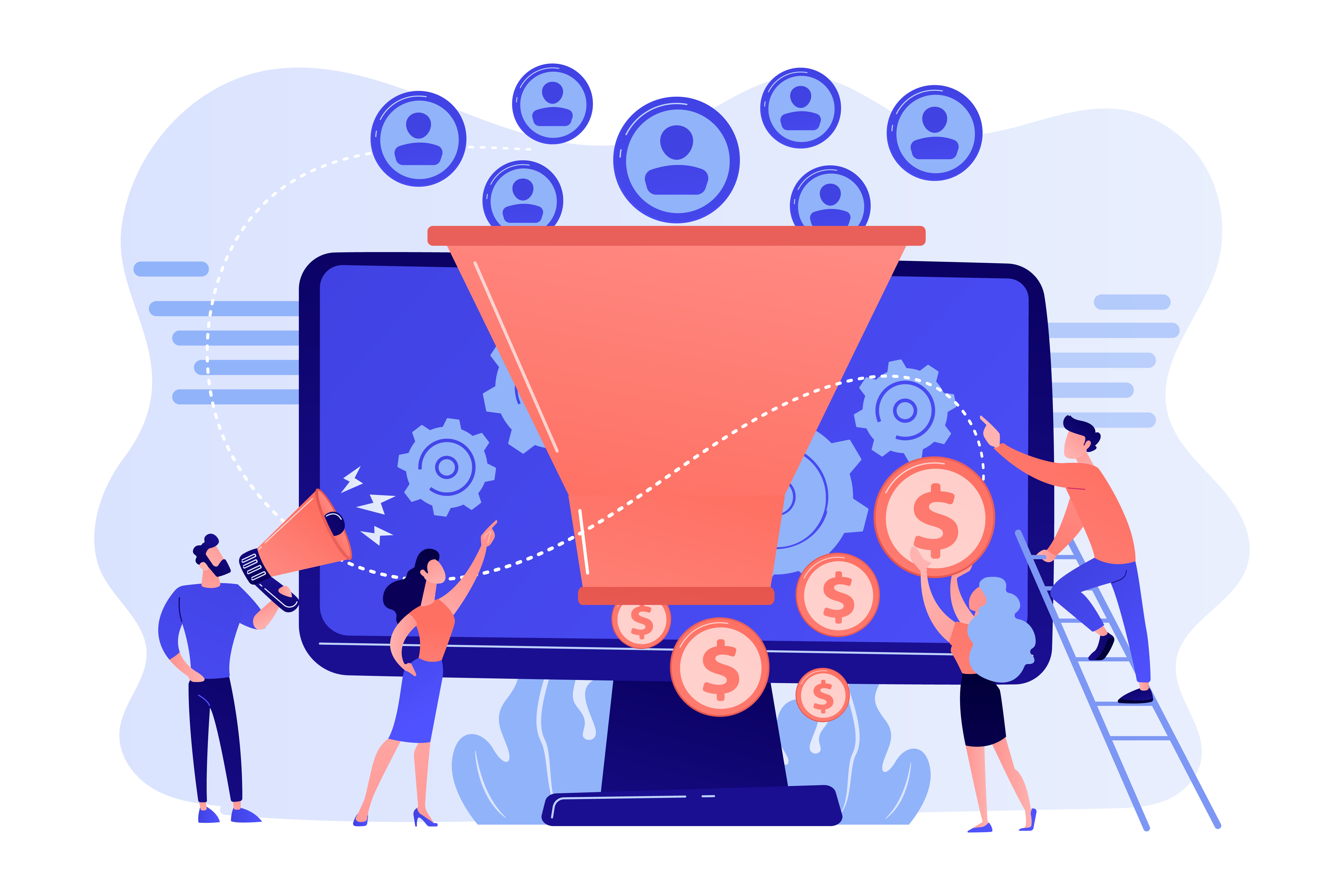
Besides pushing the organic ‘blue links’ further down the fold, AI search features also permanently altered the SEO sales funnel.
Traditionally, users would begin almost every buying experience on a search engine like Google.
By using commercial and transactional keywords, like ‘best gaming laptop 2025’, consumers would visit various websites to compare prices, read buyer’s guides, and analyze round-ups (like ‘Top 10 Gaming Laptops in 2025’).
For marketers, this formed a clear, linear sales funnel:
- Catch your audience’s attention and build trust with informative, educational content
- Convince them that your product is better than the competition
- Convert them with strong landing pages and CTAs (calls to action)
Thanks to generative AI platforms, the once linear funnel has become a nonlinear loop.
The reason is simple.
People trust AI systems, especially in terms of online shopping. According to research, 60% of consumers already use AI to shop, and they trust its recommendations more than those of their friends and family.
AI chatbots are also excellent at finding exactly what the user is looking for, which allows them to skip stages of the funnel.
Here’s an example.
Let’s say that you’re in the market for a new mouse that’s ideal for gaming and office work. Instead of conducting numerous searches on Google, you can just ask ChatGPT: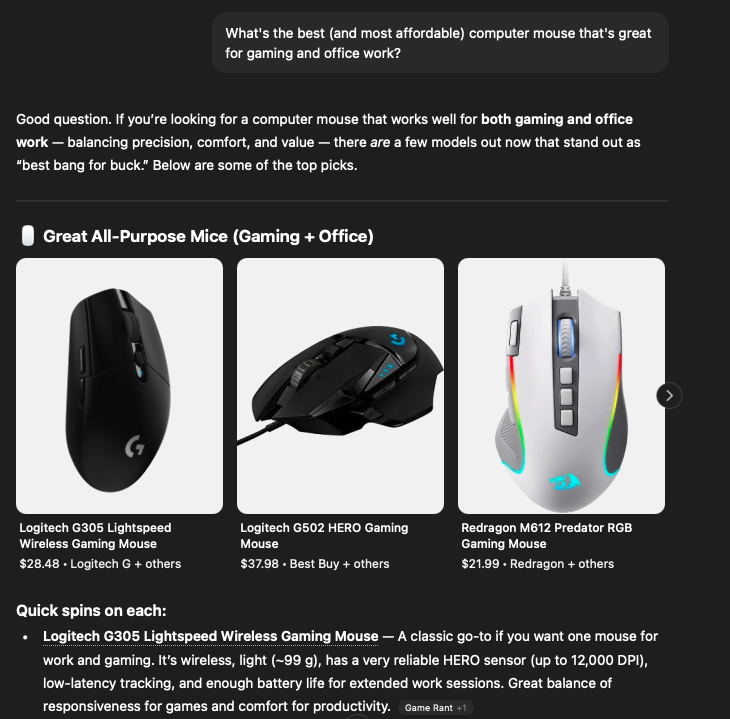
Voila, we’ve got three high-quality options to choose from, complete with pictures and brief descriptions. If you trust ChatGPT (as many users do), then you might just purchase the first option straight from the chat window.
In this instance, you jumped straight from the awareness stage to the conversion stage, skipping the consideration stage entirely.
This isn’t just a fictional scenario; it’s now an extremely common occurrence, and it’s a big reason why marketers are transitioning to GEO.
How AI citations fuel online visibility 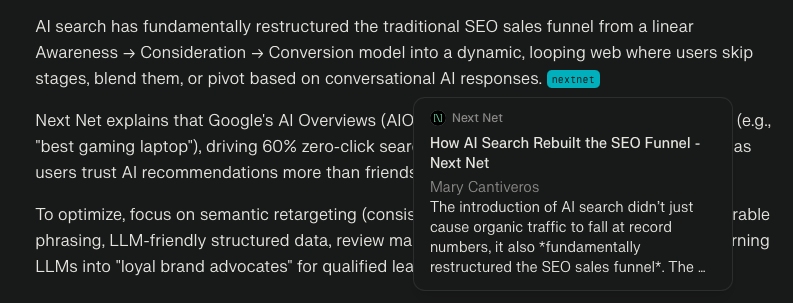
Online shopping isn’t the only arena where generative AI is taking over.
Due to the presence of AI Overviews on both Google and Bing, LLM-powered experiences are dominating traditional search experiences, like:
- Learning quick definitions to new terms
- Finding out the latest industry news
- Educational experiences, like learning how to do something new
- Learning new concepts
- Finding relevant statistics
Before AIOs, these search experiences drove lots of traffic to websites ranked on page one.
After AIOs, zero-click searches have exploded since users are able to get the information they need straight from the results page.
As we mentioned in the intro, the presence of an AIO negatively impacts the click-through rates for the organic results, even for sites in the #1 position.
What’s the new way to improve online visibility? Is it still possible to generate leads and sales through content?
The answer is getting your brand cited and recommended by generative AI tools, which is the philosophy behind GEO.
Instead of ranking in the #1 position for important keywords, the new play is to get LLMs to trust your brand and recognize it as an authority figure in your industry.
Next, let’s explore how GEO can be even more beneficial to your brand than classic SEO.
GEO vs. SEO: How Do The Benefits Compare?

Here’s a surprising fact that not a lot of marketers are starting to realize: when done properly, GEO has the potential to dwarf standard SEO in terms of leads, revenue, and other benefits like awareness.
First, AI traffic converts at higher rates than traffic from the organic results.
Here are some stats backing this up:
- According to Semrush, 1 AI visitor is worth 4.4x the average organic visitor.
- AI visitors have first-session conversions 73% of the time. Organic visitors only convert during the first visit 23% of the time. (SuperPrompt).
- Ahrefs discovered that AI accounted for 0.5% of its traffic, yet AI visitors drove 12.1% of all new signups. In comparison, their AI traffic converted 23x better than their organic traffic.
Besides higher conversion rates, GEO opens up a vast semantic range of prompts and keywords that your website can get cited for.
Rather than targeting one keyword at a time like you do in SEO, LLMs link concepts instead of keywords.
Translation?
Your content doesn’t have to contain exact-match keywords in order to get cited by AI tools.
If what you produce is relevant in context, then it’s capable of being cited by LLMs.
For instance, ChatGPT may cite an article called Photography Tips for 2025 in its response to a user prompt that asked, “How can I take better pictures?”
Even if the article doesn’t contain the exact phrase ‘take better pictures,’ ChatGPT knows that the photography guide is relevant and could help the user improve their photography skills.
Yet, in order to earn lots of AI citations, your content needs to have certain optimizations in place, such as:
- Lots of high-quality content covering your topical universe in as much depth as possible.
- Brand mentions and backlinks from credible, contextually relevant websites.
- Structured data like schema markup and semantic HTML to make your content easy for LLMs to parse, understand, and cite.
- An overall positive brand sentiment from your reviews and community discussion (social media, forums, etc.).
With strong GEO, there’s a chance that LLMs will begin to view you as the ‘prime authority figure’ for topics related to your business.
This is an incredibly powerful position to be in, because you’ll generate citations for keywords and prompts that are related to your niche but that you didn’t painstakingly optimize for one at a time.
Here’s a quick breakdown of the differences between GEO and SEO in terms of marketing benefits:
| GEO | SEO |
| Opens up a semantic and contextual range of keywords and prompts | Requires optimization for one keyword at a time |
| Traffic converts at higher rates | Can still generate lots of traffic, but it leads to fewer conversions |
| Is rapidly becoming the norm | Is slowly transforming into GEO |
| Online shoppers trust AIs’ recommendations enough to convert in a single session | Single-session conversions do happen, but are more rare and rely on content quality |
SEO is Evolving with GEO, Not Being Replaced
We should clarify that GEO isn’t replacing SEO, but becoming a core subset of it.
Essentially, it’s the AI layer of SEO, and the two work hand-in-hand.
For example, GEO still relies on many SEO fundamentals, like:
- Crawlability
- High-quality content
- E-E-A-T (expertise, experience, authoritativeness, and trustworthiness)
- Site structure (internal links and URLs)
- Topical authority
- Structured data (essential for Rich Results and AI Overviews)
In other words, GEO operates in the house that SEO built.
The catch is that GEO focuses on AI visibility, while SEO focuses on ranking in the top 10 ‘blue link’ results.
Also, as Google continues to update its core ranking algorithm with more machine learning elements, the lines between SEO and GEO will really start to blur.
Our suggestion?
Merge the two and start implementing best practices for both.
How to Shift into a GEO Mindset: New KPIs

Transitioning to GEO does require a different mindset and a new set of KPIs to track your progress.
Here are the essential KPIs for monitoring AI visibility:
- Brand mentions and backlinks – Keep an eye on your brand mentions and backlinks. Focus on editorial quality and relevance over general authority scores (like DA and DR).
- AI citations – Tools like Semrush, Ahrefs, and BrightEdge’s AI Catalyst will let you know how many citations you’re earning from all major AI platforms, like ChatGPT, Perplexity, and Gemini.
- AI Overview keywords – Which keywords are you getting cited for in AIOs?
- Brand sentiment – Pay attention to your online reviews and reputation on social media and community forums.
- AI share of voice – How much of the AI pie is your brand getting in comparison to other websites in your niche?
- Conversion rate from AI traffic – Are your AI visitors converting once they get to your site? If the answer is no, your landing pages and CTAs need some work.
Concluding Thoughts: GEO vs. SEO
GEO and SEO aren’t necessarily conflicting forces. They’re both ways to improve your online visibility, and they work off the same foundation.
At the same time, generative AI platforms aren’t something marketers should ignore.
Adapting to GEO sooner rather than later is the best way to remain ahead of the competition. 2025 is still early in terms of AI search, and it’s the perfect time to establish a breakaway lead for your brand.
Do you want to improve your visibility on major AI platforms?
Set up a strategy call with our team to find out how.