















































































































































Answer engine optimization (AEO) is slowly taking over the organic search marketing world.
Why’s that?
For one, Google is increasingly resembling an answer engine instead of a true search engine.
An answer engine is a search tool that provides direct answers to user queries instead of listing a series of hyperlinks to online sources.
Google’s AI Overviews are a perfect example of this.
Instead of foraging through the organic results to find answers (the 10 blue links), users can instantly find quick answers, definitions, and recommendations straight from the results page.
ChatGPT, Perplexity, and Claude are also answer engines, and they’ve been rapidly rising in popularity recently.
As a result, answer engine optimization (AEO) has emerged as a new way to market your products and services online.
It’s distinct from SEO (search engine optimization) because it focuses primarily on AI-driven answer engines.
This guide breaks down AEO vs. SEO differences, metrics, and strategies, plus how to blend both for peak visibility in 2026.
What is AEO, and How is it Different From SEO?

To understand how AEO differs from SEO, let’s kick things off with a formal definition.
Answer engine optimization is the practice of structuring your online presence in a way that AI-driven answer engines can easily extract, understand, and cite your content in synthesized answers to user queries.
In other words, AEO is all about improving your visibility on AI-powered tools like ChatGPT, Perplexity, and Google’s AI Overviews.
SEO, on the other hand, focuses on optimizing your online presence to rank higher in the organic search results on classic search engines like Google, Bing, and Yahoo.
As a result, AEO and SEO are fundamentally different marketing practices, despite sharing similar names.
Besides focusing on different platforms (AI answer engines vs. regular search engines), AEO and SEO also involve different optimization techniques, although there is some overlap.
AEO and SEO best practices: Differences and overlap
Common AEO tactics include:
- Structuring content into self-contained snippets
- Earning digital PR brand mentions and editorial backlinks
- Improving your brand’s online reputation through strong user reviews and community interaction
- Fleshing out your brand’s topical universe through high-quality content clusters
- Publishing content that attracts news coverage and brand mentions
- Improving technical factors like site speed and structured data
SEO best practices look different but mirror some of the same processes:
- Targeting lexical search keywords
- Creating keyword-rich content
- Building authoritative backlinks (both quality and quantity)
- Making technical tweaks to improve rankability (like improving site speed and resolving crawling errors)
- Optimizing metadata and other on-page factors
As you can see, both methodologies involve technical SEO and building backlinks, but the way you go about both differs depending on whether you’re engaging in AEO or SEO.
With AEO, technical SEO focuses on structured data (semantic HTML and schema markup) and user experience enhancements (site speed, URL structure, etc.).
For classic SEO, technical SEO primarily involves resolving crawling and indexing errors and fixing broken backlinks.
The same is true with link-building:
- AEO focuses on editorial quality and contextual relevance
- SEO uses link graph signals to weigh authority, so backlink quality AND quantity both impact search results
That means the same practice can look drastically different depending on your methodology of choice. You’re using the same tools, but you have different optimization goals.
Here’s a breakdown of the main differences between AEO and SEO:
| Aspect | AEO | SEO |
| Goal | Become the #1 source AI answer engines cite for relevant queries | Rank #1 for search keywords relevant to your business |
| Content style | Concise FAQs, brief self-contained snippets | Keyword-rich, long-form content (typically over 2,000 words) |
| Metrics | AI citations, share of voice impressions, snippet wins | Organic traffic, rankings, CTR |
| Tactics | Semantic clarity, schema markup, topical authority, digital PR backlinks, editorial brand mentions | Backlinks, keyword-aligned content, technical SEO |
| Timeline | AI pickup can occur in weeks | 3 – 6 months to gain momentum, and then compounding after that |
Organic SERPs vs. AI-Generated Answers: SEO vs. AEO in Practice
Next, let’s see how the same query plays out differently in a classic SERP vs. an AI-generated answer.
Doing so will help you understand the difference between AEO and SEO in terms of structure and the ability to generate traffic.
For this example, we’ll use the query ‘how do CNC machines work?’
Here’s what Google’s organic SERP looks like (with AI Overviews turned off):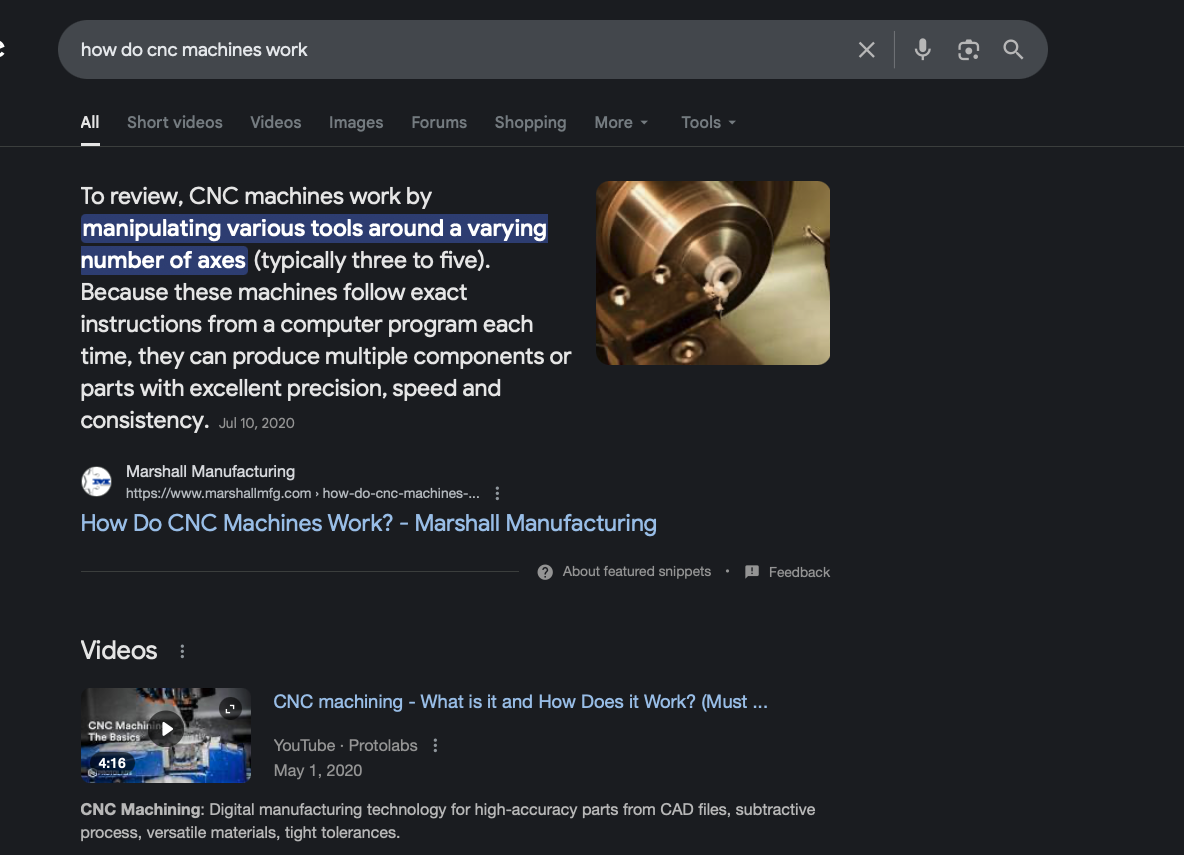
As you can see, there’s a featured snippet alongside an organic result at the very top of the page. Underneath that, there’s a video panel.
These are both SERP features that have been around for quite some time.
However, even without AI Overviews, Google’s current results pages are absolutely stacked with SERP features.
Today, it’s rare to see 3 organic results in a row unbroken by a SERP feature. Here, the first result is a Reddit post, and the next two get interrupted by a SERP feature panel: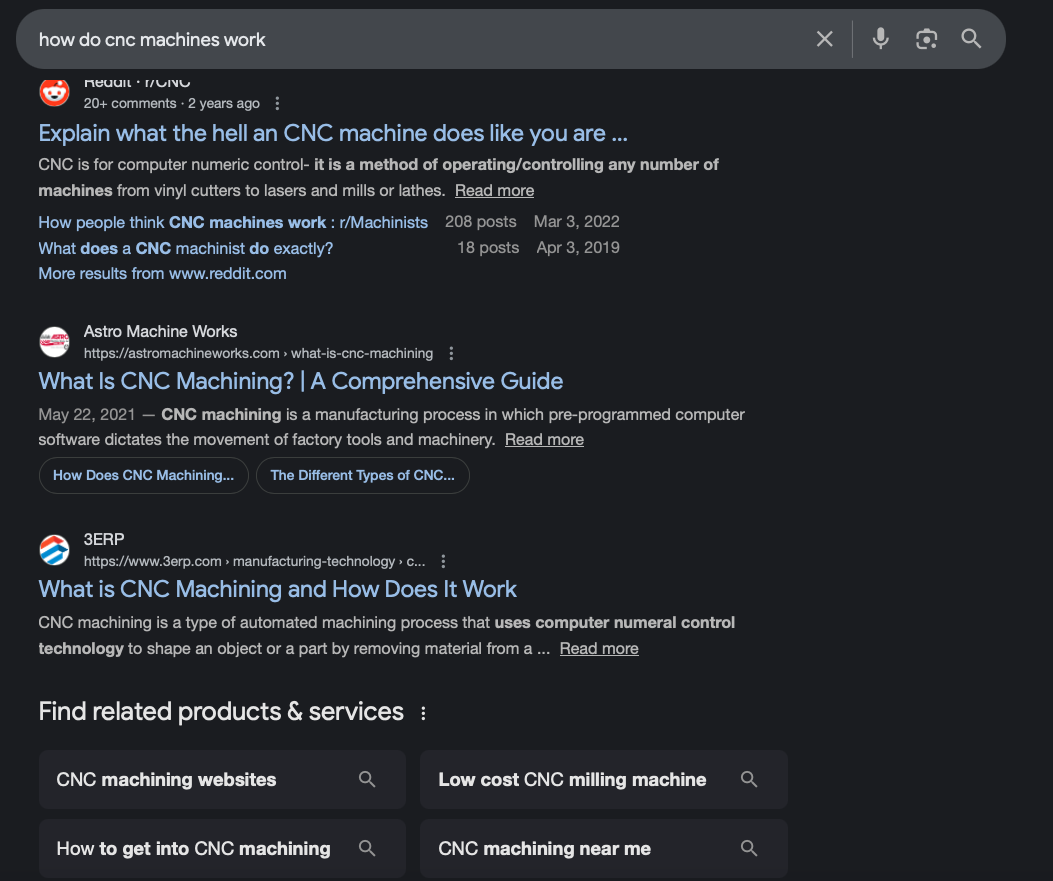
As we continue to scroll down, there’s only room for 2 more organic results because of the People Also Ask panel: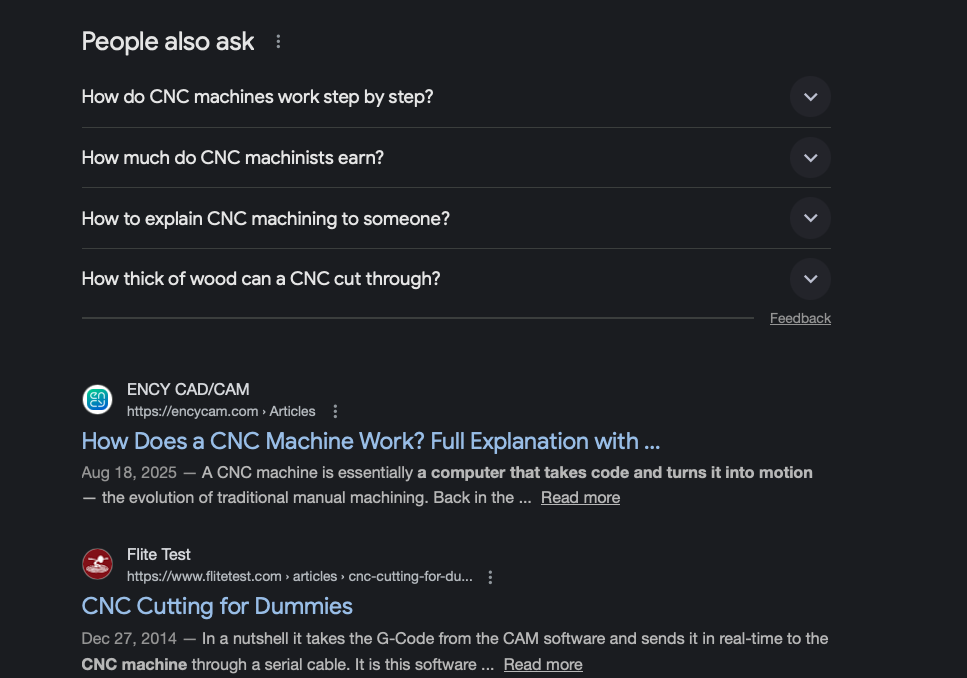
In other words, the modern organic SERPs are a battlefield for page real estate.
In fact, contrary to popular belief, there are no longer 10 organic results per page. Most queries will deliver 6 – 8 results (or fewer), with the rest of the page real estate dominated by AI Overviews and SERP features.
This is a major reason why it’s been increasingly difficult for brands to generate traffic through Google’s organic search results.
It’s also why including AEO is a must for all brands. Without it, you’re left fighting for the handful of organic keyword rankings that actually appear on page 1.
Here’s the same query but with AI Overviews enabled: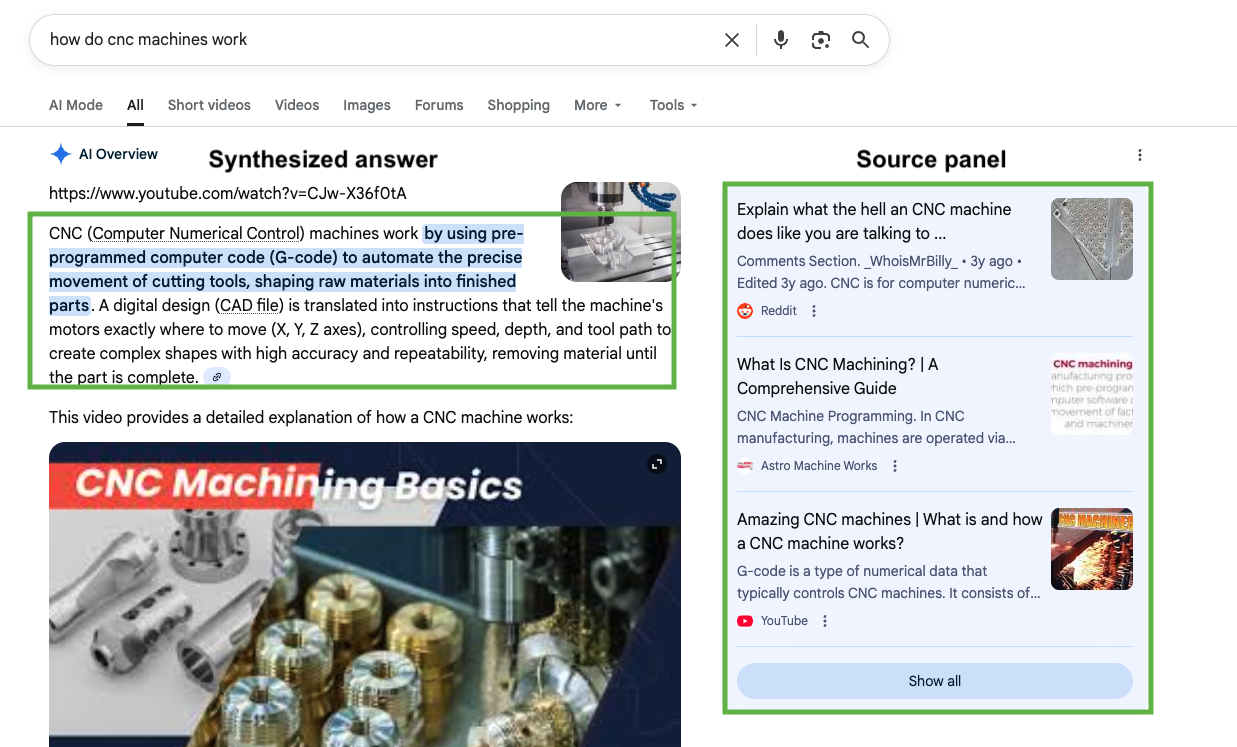
Here, there’s a synthesized answer that directly answers the user query alongside a source panel. With AEO, getting your brand cited in the source panel is the new version of page 1 keyword rankings.
Even if users leave the page without directly clicking on any results in the source panel, it still places your brand front and center for relevant queries, which raises brand awareness and can lead to direct site visits down the line.
Brands are already noticing this, which is why AEO is beginning to take off. According to Search Engine Land, brands that are cited in AI Overviews receive 35% more organic clicks and 91% more paid clicks than those not cited.
How to Shift Your Strategy from SEO-Only to AEO + SEO

Let’s be clear: adapting to the modern search landscape isn’t about abandoning your SEO campaigns in favor of 100% AEO.
Instead, it’s about incorporating AEO best practices into your existing SEO strategy.
That way, you’ll have all your bases covered in terms of earning organic visibility online. If your audience misses you in the organic results, they’ll undoubtedly see you popping up in AI Overviews and synthesized answers on tools like ChatGPT.
Here are some tips for injecting AEO into your SEO pipelines.
Content creation and structure
Both SEO and AEO require content creation, but AI-driven answer engines have specific preferences you must cater to if you want to earn citations.
For one, AI systems ingest content in fixed token chunks of about 300 – 500 tokens at a time. These chunks are self-contained, meaning AIs evaluate snippets of your content and not the entire piece.
For example, if an answer engine like Perplexity is tasked with providing the pros and cons of CNC machines, it will pull snippets from articles that directly discuss CNC machine pros and cons.
If you have a guide called ‘How CNC machines work,’ Perplexity won’t pull the entire guide to synthesize answers. Instead, it’ll pull the subheading called ‘Pros and cons of CNC machines’ to find the exact information it needs.
What about the rest of the piece?
It won’t be considered, only the relevant chunk.
As a result, you have to structure your content to cater to this process. Here are some tips:
- Use subheadings as topical boundaries. Every time you mention a new subtopic, contain it in an H2 or H3.
- Directly answer the questions you pose. If you present a question in a subheading, you should immediately answer it in the first sentence. This makes it easy for LLMs to parse, understand, and cite your Q&A content.
- Make frequent use of tables, bulleted lists, and FAQ sections. Concise formatting is also a must, so stick to short paragraphs and sentences. Also, LLMs prefer tables and bulleted lists because they’re easy to extract information from, so make frequent use of them.
Technical optimization
On the technical side, structured data is one of the most important aspects of AEO.
Semantic HTML and schema markup act as special labels that define aspects of your content. Structured data removes ambiguity and gives LLMs the confidence they need to cite your content.
Essential schemas include FAQPage, HowTo, Article, Author, Product, and Organization. These make clear A) the type of content you’re producing, B) who produced it, and C) how it pertains to a user prompt (like answering a question or providing steps to learn a new skill).
Digital PR and authority
In AEO, editorial quality and relevance matter most for building authority.
In particular, digital PR links from news sites and media outlets carry the most clout because they demonstrate human judgment and editorial discretion.
Whenever a credible news outlet covers your brand, it signals trust to AI systems because:
- News outlets have legal obligations for factual accuracy
- They use a team of human editors and publishers
- There’s fact-checking and proofreading involved
As a result, the chances that news coverage is inaccurate or manipulated are very low.
Also, even unlinked brand mentions can boost your authority on AI-driven answer engines. That’s because LLMs are sophisticated enough to identify whenever other sites mention your brand by semantics alone (no links required).
As a bonus, editorial coverage and backlinks also improve traditional SEO, so you’ll enjoy the best of both worlds.
Tracking and monitoring
The good news is that a lot of popular SEO tools now include AEO features. In particular, Ahrefs and Semrush have ways to:
- Keep track of your AI citations across multiple platforms
- Visualize your industry’s AI share of voice
- Identify competitor gaps in AI Overviews
Manual tracking is also possible, although it’s a bit slower. It works by keeping track of the prompts/topics you target in a spreadsheet, then manually prompting tools like ChatGPT to see if you get cited.
Final Thoughts: AEO vs. SEO
To summarize, AEO and SEO are both fundamentally different marketing practices, but they’re similar enough that you can combine them both into one cohesive strategy.
As Google and other legacy search engines continue to transform into answer engines, AEO is becoming something brands can no longer ignore.
For now, marrying both is the best way to maintain current visibility while paving new ground for the future.
Do you need professional help adapting to AEO?
Reach out to our team to discover the best path forward for your brand.